
By Robert Romero Jr.
Published
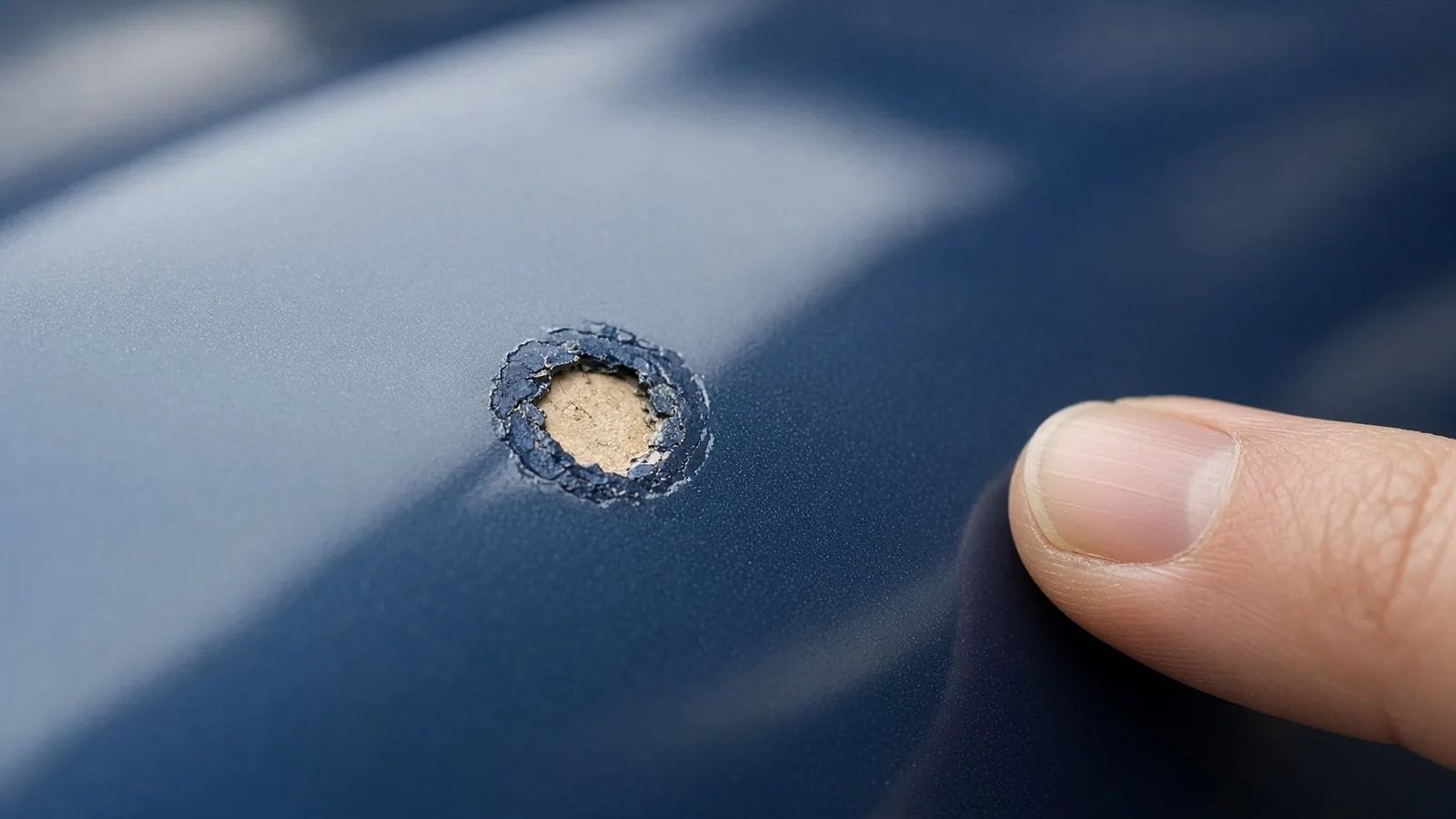
AI-generated illustration of a chip that has opened the finish, shown next to a fingernail. Not a customer vehicle and not a result of paint correction.
The short answer
Southern Auto Detailers assesses paint at the studio in San Antonio, not in a driveway. Paint correction is the service page. What paint correction involves is the overview. This piece is only about the limit.
Leveling is not filling
A fine wash mark is a shallow trough in the clear coat. If the surrounding clear coat is lowered to the bottom of that trough, the trough is gone. That is the idea behind correction. The same article on DetailingWiki says polish does not hide defects, it removes them. Hiding would be a filler sitting in the groove. Fillers wash away. Leveling is permanent only in the sense that the clear coat you removed does not grow back.
That last point is the limit. Clear coat is a finite layer. DetailingWiki’s “Minimum paint thickness” page, indexed as 17 November 2017, uses strike-through for clear coat polished away until the color shows, and burn-through for color removed until primer shows. The page warns that average thicknesses are unsafe because real panels vary. This article does not repeat that page’s sample micron counts or its “how many polishes” arithmetic.
The studio does not offer wet sanding as a way around this limit. An older DetailingWiki swirl article (indexed 17 February 2016) says a scratch that catches a nail is too deep for machine polishing alone and then mentions filling and wet sanding. That suggestion is not a service here. Wet sanding removes clear coat quickly. If a mark needs bodywork or a repaint, polishing is the wrong tool.
What the diagram actually shows
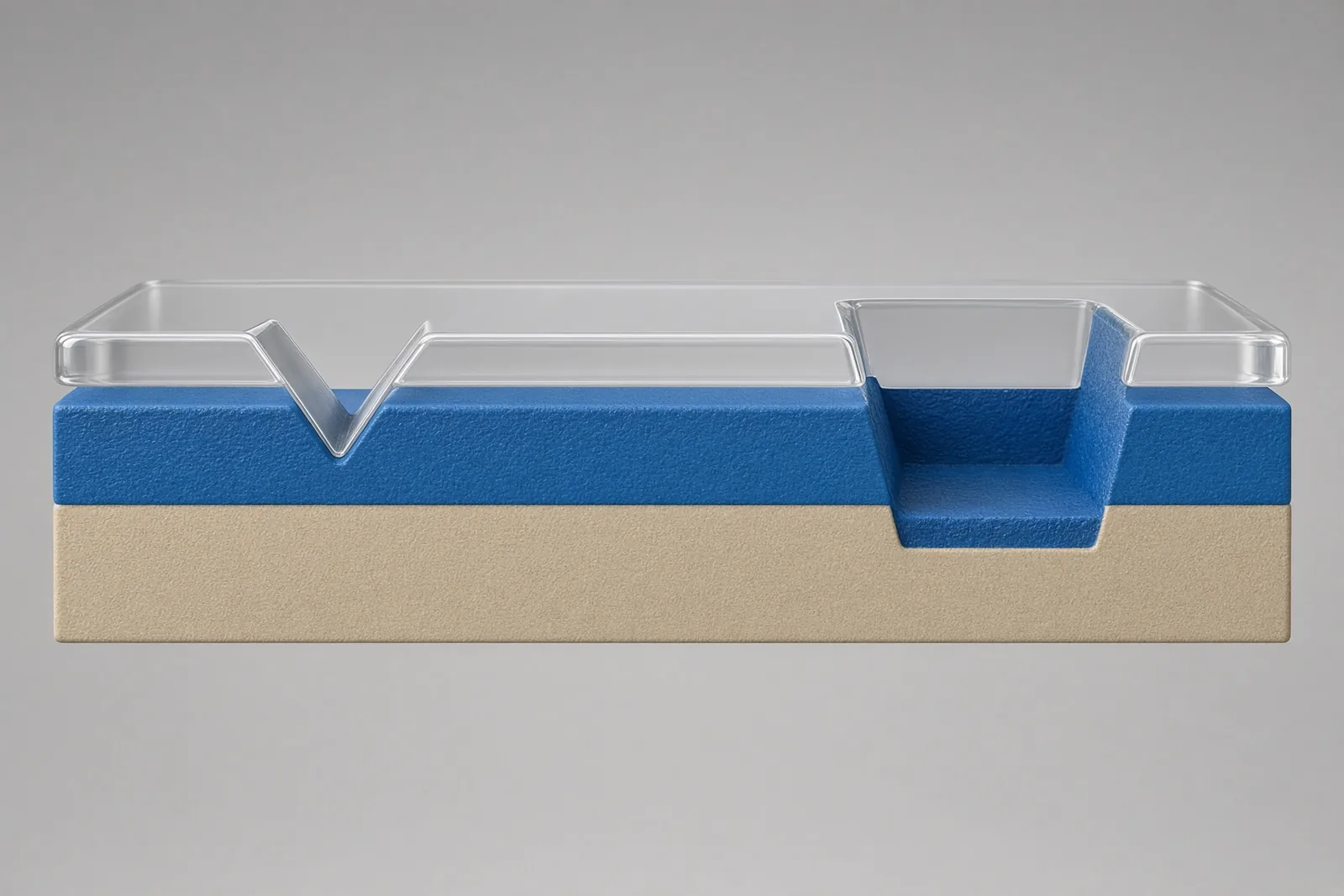
The model below has two open defects, and both already pass the clear layer. Read it that way. It is not a picture of a “light” scratch next to a “deep” one.
A shallower mark, the kind correction is meant to discuss, would stop inside the clear layer and would not touch the color. That case is not drawn here, because the generated model could not show it without also cutting the color layer. The distinction still matters in words: if you can see a different color in the bottom of the chip, you are no longer looking only at clear coat.
DetailingWiki’s “What is paint repair” page (indexed 3 January 2017) says a scratch can be too deep to polish out, a stone chip can remove clear coat, and clear coat can flake. In those cases the wiki points toward paint repair, not another polishing pad. This studio does not repaint panels. Correction is refinement of the clear coat that is still there.
- The left groove cuts through the clear layer and into the blue color layer.
- The right chip is open from the top and reaches the beige layer under the color.
- The layers are a teaching model. They are not your primer, base, and clear, and they are not to scale.
The fingernail check is a clue, not a measurement
Run a clean fingernail across a mark lightly. If the nail does not catch and the mark is mostly a trail you see in sunlight, it may be a shallow clear-coat mark of the kind people call a swirl. Swirl marks from car washes is the article on that pattern. If the nail stops in the groove, the 2016 wiki note treats that as too deep to remove by machine polishing alone.
Use that only as a way to describe the car when you book. A catch can be a sharp edge, a chip, or a ridge of contamination. It is not a paint-thickness reading. Two marks that both catch can have different futures. Nobody can promise which is which from a text message.
The photograph is an illustration of an open chip with a lighter center and a fingernail beside it. It is not a measured defect and not a car the studio has corrected.
A hypothetical door, not a customer story
Imagine one driver’s door with three different marks. This is a teaching example, not a car we have seen.
The useful booking note is which of the three you actually have, and a photo taken along the panel rather than straight at it.
- Fine circular trails. Your nail does not catch. That is a correction conversation. The outcome still depends on the clear coat.
- A line where your nail catches. It might improve, or a trace might remain. Inspect it. Do not promise it will vanish.
- A chip with a pale dot that is not the door color. Polishing will not manufacture paint, and a ceramic coating does not hide swirls.
What the studio will and will not say
Paint correction in San Antonio is the page for refining clear coat that remains. It does not claim every scratch leaves. If the clear coat is already thin, the right decision can be to stop. The 2016 swirl article makes that tradeoff: removing every deep mark can cost more clear coat than the panel should give up.
Correction is also not part of a wash, an exterior detail, or a full detail unless it is quoted. A full detail cleans the cabin and the outside. It does not include machine polishing by default.
If a coating is the later goal, the order is still inspection, then whatever correction you agree to, then the film. Sealing a chip under a coating does not fill the chip. The coating page is where that second decision lives.
Bring the mark, not a guess
If you are unsure whether a line is a wash swirl or a chip, send a photo along the panel and say whether your nail catches. Book paint correction only if you want the clear coat refined after that look. For a wash and a cabin reset without polishing, say so. Call (210) 201-4847 or use the contact form. The car is worked on at the studio, including for customers coming from Schertz or the rest of the northeast side. Schertz is a service area, not a second location.
Sources
- DetailingWiki, “What is a polish.” https://www.detailingwiki.org/correction/what-is-a-polish/. No date on the fetched page. Quoted for polishing as removal of a thin layer, and for polish not hiding defects.
- DetailingWiki, “Minimum paint thickness.” https://www.detailingwiki.org/correction/minimum-paint-thickness/. A search index listed 2017-11-15. The fetched view explained strike-through and burn-through and warned against relying on average thickness. Sample micron counts from that page are intentionally not reused as instructions.
- DetailingWiki, “Removing swirls – basic.” https://www.detailingwiki.org/correction/removing-swirls-basic/. A search index listed 2016-02-17. The nail-catch remark and the caution about removing too much clear coat are from that indexed text. The page’s wet-sanding suggestion is not adopted.
- DetailingWiki, “What is paint repair.” https://www.detailingwiki.org/detailing-miscellaneous/what-is-paint-repair/. A search index listed 2017-01-03. Used for the point that some scratches and chips are past polishing.
- I did not re-measure any vehicle, and I did not run a paint-thickness gauge for this article.